The surge in foreign property investment across various provinces in Spain remains notable, with a discernible uptick in their market presence. According to the Property Registrars’ data for the second quarter, foreign buyers accounted for a significant 14.94% of total real estate transactions nationwide, marking the second-highest result in recorded history.
This resurgence in foreign buyer activity, after a lull in the previous quarters, comes against a backdrop of a general decline in overall transactions. The registrars highlight the foreign market’s importance in sustaining substantial volumes in real estate deals.
The Mediterranean coastal regions and islands continue to attract substantial foreign demand, as seen in Alicante, Santa Cruz de Tenerife, Málaga, and the Balearic Islands. In these provinces, buyers from other countries purchased a staggering 30% or more of all properties sold, effectively doubling the national average. Leading this trend, the Costa Blanca reported nearly 45% of transactions attributed to foreign buyers, with Alicante standing out as the province where 40% of property sales involved non-Spanish purchasers. Subsequent provinces on this list include Santa Cruz de Tenerife with 38.01%, Málaga with 32.02%, and the Balearic Islands with 30.38%.
Beyond these regions, provinces like Girona, Murcia, Las Palmas, Almería, and Tarragona also witnessed a higher-than-average share of foreign investment, contributing between 29.2% and 15.8% of the total transactions between April and June.
However, it’s noteworthy that while regions like Castellón, Valencia, and Barcelona registered double-digit shares, a vast majority of the remaining provinces had foreign buyers accounting for less than 10% of the market. Provinces like Granada and Zaragoza saw only 7% of their property deals involving foreign purchasers, while in others like Madrid, Teruel, and Guadalajara, the share stood at 6%.
In certain provinces, the presence of foreigners in property transactions is even lower, with A Coruña, Albacete, Pontevedra, Palencia, Cáceres, Córdoba, and Zamora recording figures below 2%.
The trend varies across Autonomous Communities, with only the Canary Islands and the Balearic Islands experiencing foreign buyers contributing to more than 30% of home transactions in the second quarter. Subsequently, the Valencian Community (29.91%), Murcia (23.56%), and Catalonia (15.35%) emerged as the most prominent regions in this regard, while Extremadura and Galicia reported a mere 2% share.
This upsurge in foreign market activity during spring led to a 0.42% increase in their share compared to the beginning of the year, inching closer to the previous record of 15.92% recorded in the third quarter of 2022.
The quarterly evolution reveals a mixed picture, with 31 provinces witnessing an increase in foreign market share, while 19 others experienced a decline and one remained stable.
The British continue to hold a dominant position historically among foreign property buyers, though their relative share has dipped slightly from 9% to 8.8%. Other prominent nationalities contributing substantially include Germans (7.25%), French (6.56%), Moroccans (5.37%), Italians (5.22%), Romanians (5.15%), Belgians (5.09%), and Dutch (4.61%).
Despite purchasing fewer than 1,000 properties in the same period, nationalities like Poles (3.92%), Russians (3.43%), Chinese (3.09%), Swedes (2.94%), Ukrainians (2.72%), and Irish (1.66%) have shown increased activity compared to the beginning of the year.
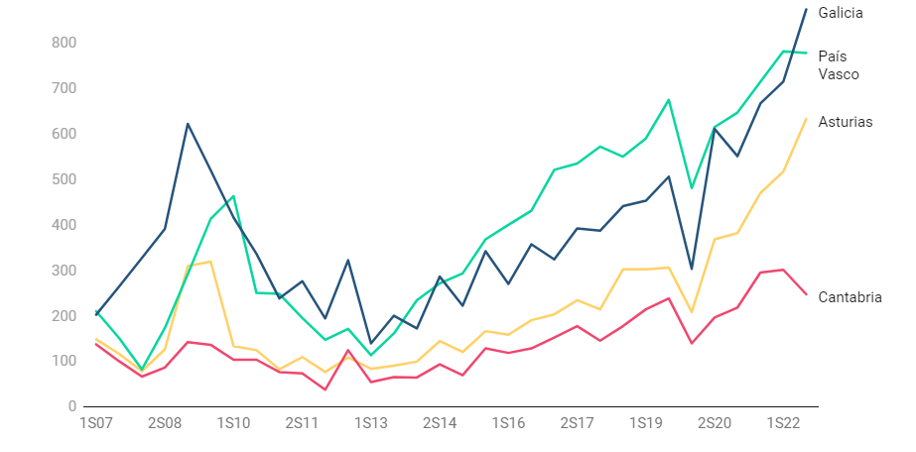
Galicia, Asturias, Cantabria and the Basque Country register significant increases in home purchases by foreigners.
She was born in London 47 years ago, but today Hannah Darvill lives and works in deep Galicia. Specifically in Toiriz, a village seventy kilometers from Lugo where it was established in 2021 after a series of coincidences. “A few years ago I decided that I wanted to live in the north of Spain: I had traveled the entire country by bicycle and I had fallen in love with Galicia, its landscapes, its greenery and its aesthetics,” he says. “After Brexit I had a deadline to apply for residency in another European country, so I took advantage and came.”
During the pandemic, Darvill Googled ‘Galicia river stone house’ and found a photo of “my dream house.” “It was an old mill in a restored house. It was in an Airbnb ad. I messaged the owners and asked if they were selling it. They said no, but later I suggested renting it to them during the winter and they said now Yes, they were thinking about selling,” he continues. “I was still interested, so I went to see it and bought it.”
It is curious, he says, that these owners were Scottish and the previous ones were English. The complex, made up of a main house and a secondary house and located in the Sobreirais do Río Arnego nature reserve, functions as a rural house. Darvill lives on that income, and when he rents the entire property in the summer he takes advantage of it to continue discovering the community by van.
The Londoner closed the purchase in November 2021, thus becoming one of the 1,218 foreigners who purchased a home in Galicia that year. In 2022 there were 1,382, almost 400 more, according to data published every six months by the General Council of Notaries. These are discrete figures, far removed from the Valencian Community, Andalusia and Catalonia, but they have been registering large percentage increases semester by semester. The trend is similar throughout northern Spain: in addition to Galicia, Asturias, Cantabria and the Basque Country.
Sales by foreigners are growing in the north.
Home sales per semester in each community
Source: General Council of Notaries
“We must keep in mind that the data is deceptive. When you have 20,000 semi-annual operations and you go to 20,010, the percentage growth is very small, but it is still many more than going from 200 to 400. That said: from time to time there are areas that become fashionable for second homes. In the eighties it was Tarragona, Benidorm had a very strong time, Jávea is full of Madrid residents…” says Laura Martínez, communications director of the mortgage comparator iAhorro. “The north is becoming more and more attractive. These provinces are doing good marketing campaigns to attract tourism, but we will have to see if the demand for residences from foreigners ends up going there.”
The nationality of buyers in the northern provinces varies. Among the non-residents, Germans and Portuguese stand out in Galicia, Argentines and Germans in Asturias, French and Americans in Cantabria and Americans and French in the Basque Country. Among residents, the Portuguese dominate in Galicia and the Romanians in the rest of the communities.
Added to the trend in the north, iAhorro has detected a drop of 2.5% in the second quarter of this year in homes acquired in the coastal provinces of the south, the east and the Spanish islands, the areas that continue to concentrate the highest number of foreign sales in Spain. Castellón and Murcia are the cheapest to buy. Its mortgage director, Simone Colombelli, attributes this decline to the rise in interest rates, which in turn have made mortgage loans more expensive.
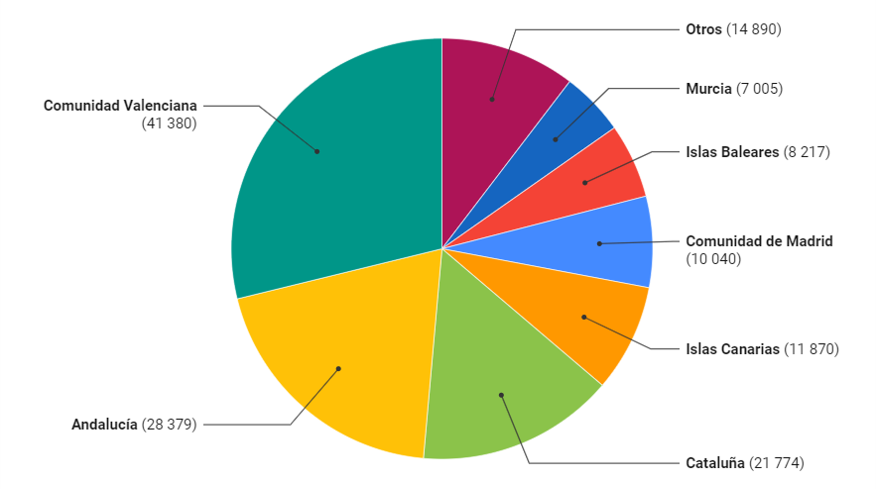
Where did foreigners buy the most homes in 2022?
Sales of foreigners by community
Source: General Council of Notaries
“Demand has reduced considerably and owners have to adapt by lowering their prices a little to be able to sell,” he says. In the case of Murcia, he also considers that “the bad publicity that the region has received due to the state of the Mar Menor has made, especially foreign buyers, opt for other options.”
From English to Dutch
Hannah Darvill didn’t buy her house alone. At that time I already knew David Imrie, a Scot living in Galicia who for years advised his compatriots who wanted to move and buy a house in the region. Imrie and his wife, from Sweden, worked in an office near London owned by Nokia. The Swedish company dominated the mobile phone market in the 90s and 2000s, but the launch of the iPhone sank its sales. So much so that in 2012 it laid off 30,000 people: among them, Imrie and his wife.
“We had very specific skills to work at Nokia, so it was going to be very difficult to find new positions. I already had a house in Galicia because during my years at Nokia I had taken the opportunity to study a master’s degree in architectural technology with the idea of, in future, dedicate myself to renovating homes,” he says. “I liked Galicia and I bought it. The climate is similar to the Scottish one, but much better than the English one. It’s not bad. And you can buy very big and cheap houses. We decided to move there and start a family.”
One of the houses that David considered buying in Galicia – DAVID IMRIE
Imrie settled in Pontedeume and set up a website to attract clients. In it he told the entire process he followed to check if one of the first houses he saw was worth it, from when he visited it until he verified the municipality’s General Urban Planning Plan established that at some point they could build a huge development behind it. He wrote more sections focused on how to find good homes and what to consider when buying them and got to work. “I had about thirty clients, both to help buy and to renovate. But in 2016 Brexit was voted and it killed my business, because all my clients were English,” he remembers.
As its website is still open, it occasionally receives emails from Europeans interested in buying. “Especially Dutch,” he says. “The profile is similar to mine: people who earn well, who work in technology and can work from anywhere. I have helped a ‘senior’ software developer and a graphic designer. I think they are people who are looking for a good balance between life and work. Buying a truly special house in London is impossible for most people. Here I have a 450 square meter house facing the estuary. It’s something I could never have afforded in the United Kingdom. That’s why people come.”
Record number of foreigners buying homes in Spain
In 2022, foreigners bought more homes than ever in Spain. According to the yearbook of the College of Registrars, there were 88,800 operations that represented 13.8% of the total sales, a record number and never seen before. In addition, the number of sales by non-EU foreigners who paid half a million euros or more (3,794) for a home skyrocketed, an operation through which they could apply for the golden visa and obtain a residence permit.
Despite Brexit, the British continue to be the foreigners who buy the most, followed by Germans, French, Belgians and Moroccans. Martínez, from iAhorro, believes that in the coming months house prices on the Andalusian and Mediterranean coasts will continue to fall, but more because of the rates than because of the heat.
Will the north fill with foreigners seeking milder temperatures as the south becomes impassable? In Asturias, the community in which the greatest percentage increase in sales was recorded in the last semester, they do not see it so clearly. “We are neither going to be filled with foreigners nor are we going to live off sales to foreigners,” declared the president of the Asturian Real Estate Association regarding the data. For Imrie, instinct tells him that demand, at least in Galicia, will continue to grow. “Before it was retired foreigners looking for a place to retire, now it’s younger people looking for a lifestyle that they can find here.”